Sentiment and intent labels that reflect the annotator’s background, not the target market’s conventions.
Annotations based on standard written language that fail on the colloquial or regional registers your users actually produce.
Generic annotators labeling medical, legal, or financial content without subject-matter knowledge.
Multilingual or mixed-language text (like Hinglish) that general annotators cannot handle reliably without native bilingual expertise.
Annotation for English NLP is well-served by general-purpose labeling platforms. Annotation for multilingual AI — particularly for Indian languages, low-resource languages, and domain-specific content — is a fundamentally different problem.
The failure modes in multilingual annotation are systematic, not random. A labeler who speaks Hindi but does not understand medical terminology will produce sentiment labels that are linguistically correct but clinically wrong. A labeler who annotates Bengali text without understanding regional dialect variation will produce NER labels that fail on real-world data distributions. A crowd worker annotating intent for a Hindi customer service chatbot who is not a native speaker of colloquial urban Hindi will mislabel at rates that make the model unreliable.
Sentiment analysis, intent classification, named entity recognition (NER), relation extraction, coreference resolution, semantic similarity, and document classification — in 197+ languages. Annotators are native speakers with domain knowledge in the subject area being labeled.
Identification and classification of named entities in text — people, organisations, locations, dates, product names, medical terms, legal references, and custom entity types. Available in all major Indian languages, global languages, and code-mixed text where standard NER tools consistently fail.
Sentence-level, aspect-level, and document-level sentiment labeling — positive, negative, neutral, and nuanced emotion categories. Intent annotation for conversational AI and customer service automation. Culturally calibrated by native speakers to reflect how sentiment is actually expressed in the target language.
Transcription verification, speaker diarization, emotion annotation, phoneme labeling, accent classification, and prosody annotation for speech recognition and voice AI training. Available in all major Indian languages and global languages — with dialect and accent coverage that standard annotation platforms cannot provide.
Object detection (bounding boxes), semantic segmentation, instance segmentation, image classification, keypoint annotation, and polygon annotation. Culturally appropriate labeling for non-Western visual contexts — annotators are briefed on the target market’s visual conventions before work begins.
Frame-by-frame object tracking, action recognition labeling, activity detection, event annotation, and video classification. Consistent annotation across extended video sequences with quality sampling throughout — not only at final delivery.
Human preference ranking, response quality evaluation, safety and alignment annotation, and instruction-following assessment for LLM fine-tuning and RLHF. Evaluators are domain-trained and language-native — producing feedback that reflects real user expectations in each target language and market.
Categorisation of structured and unstructured data — content moderation labels, topic classification, document type labeling, spam detection, and multi-class classification for training supervised learning models. Custom taxonomy development included for projects with non-standard label sets.
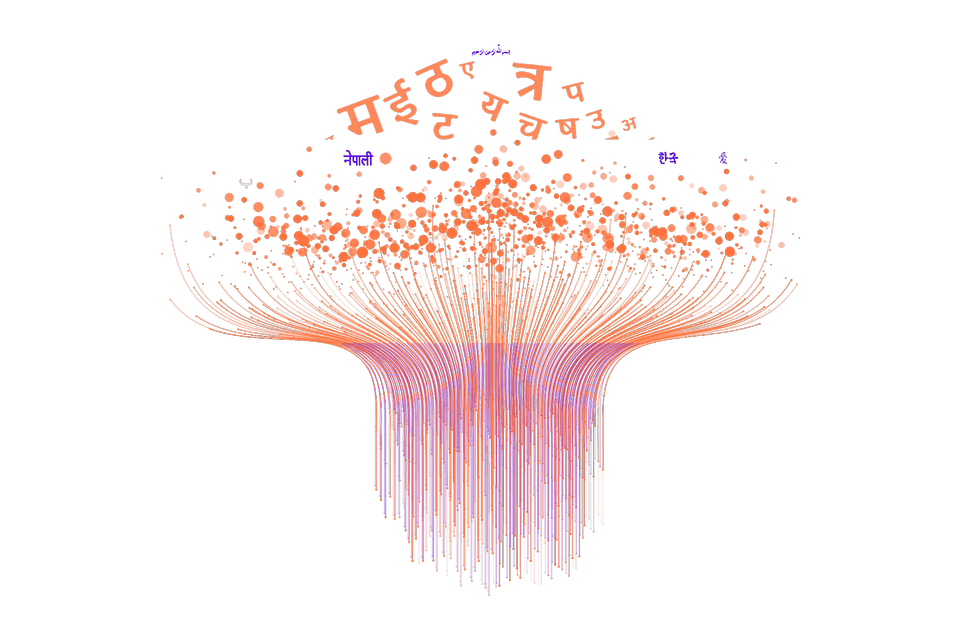
Hindi · Bengali · Telugu · Marathi · Tamil · Urdu · Gujarati · Kannada · Odia · Malayalam · Punjabi · Assamese · Maithili · Santali · Kashmiri · Nepali · Sindhi · Dogri · Konkani · Manipuri · Bodo · Sanskrit
Hinglish (Hindi-English) · Tanglish (Tamil-English) · Bengali-English · Telugu-English · and others
Step 1 —
Annotation schema, label taxonomy, edge case guidelines, and quality targets documented and agreed before the first item is labeled. We do not begin production annotation until the schema is unambiguous.
Step 2 —
Native-speaking, domain-specialist annotators selected per language and subject area. Every annotator is briefed on the schema, reviewed on a calibration batch, and must pass a quality threshold before entering production.
Step 3 —
A pilot of 200–500 items is annotated, measured for inter-annotator agreement (IAA), and reviewed before full production begins. Schema ambiguities are resolved at this stage.
Step 4 —
Full-scale annotation with random sampling quality checks throughout. Annotators receive specific feedback on flagged items — not just rejection.
Step 5 —
If you are building AI for Indian users, you need annotation in the languages Indian users actually speak — including dialects, code-mixed varieties, and the colloquial registers that general platforms do not cover. We cover all 22 scheduled Indian languages with professional linguist oversight.
Every new annotation engagement starts with a pilot batch of 200–500 items. You confirm the schema works, the quality meets your threshold, and the annotators understand your domain before scaling. No large commitments before quality is confirmed.
Based in New Delhi and Bhopal. Available in your timezone for project reviews, schema calls, and delivery discussions. No international markup, no coordination overhead.
Every annotation project is assigned to native-speaking linguists with domain expertise. We do not route projects through a crowd platform. This produces measurably higher inter-annotator agreement, fewer schema violations, and annotation that reflects how language is actually used in the target market.
Languages annotated
Indian languages covered
Years of language data experience
Need raw data before you can annotate? We collect speech recordings, text corpora, and dialogue data across 197+ languages — purpose-built for your model requirements.
Human expert review of AI-generated translation output. The same quality-first approach we apply to annotation, applied to language quality assurance.
Overview of all our AI data services — annotation, collection, dataset QA, and RLHF data — in one place.